


Galtea is an evaluation platform for generative AI products, from pre-release testing to monitoring in production. Every version of an assistant or agent is measured against explicit, repeatable criteria, so the decision to ship rests on comparable results and is documented.
What's new at a glance
| Update | What it solves |
|---|---|
| Agents with streamed replies (SSE and NDJSON) | Evaluate the agent as it is deployed and measure its time to first token |
| Cost and tokens per call | Attribute spend to each specific call within a trace |
| Metric revisions against human annotations | Check the judge's criteria before trusting its scores |
| New judge models deployed in the EU | More evaluator options with a European deployment |
| Usage report by product (alpha) | See the evaluation activity created in each product |

Want to see how your own agent is evaluated?
How do you evaluate an AI agent that streams its replies?
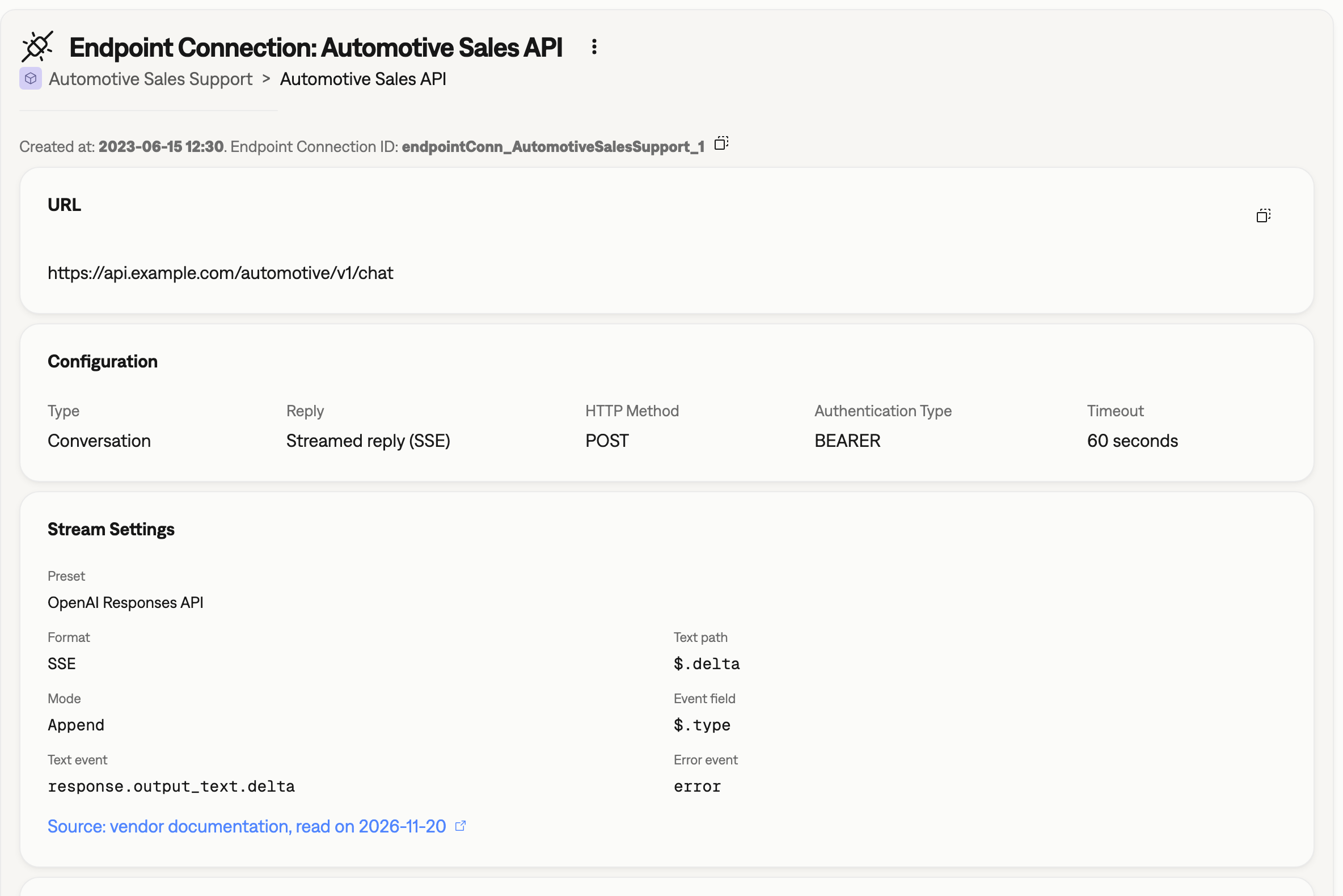
A streaming agent delivers its answer in chunks while the model generates it. Evaluating it means reading that stream and rebuilding the full output. Galtea's Endpoint Connections, which call the agent's endpoint, now accept replies streamed as Server-Sent Events (SSE) or as one JSON value per line (NDJSON). Galtea joins the chunks into a single object, and the output mapping can read the full text, the chunks of each event and the last event.
In the dashboard, select Streamed reply in the connection form and pick your agent stack. The same configuration is available in the Python SDK and the CLI, with presets for common formats.
Traces produced from these replies also record time to first token: the interval between the request and the first chunk that carries text. It appears next to latency and separates how long the agent takes to start from how long it takes to finish.
How much does each LLM call cost?
The page of each span (one step within a trace) now breaks down the cost of the call: input tokens, cache read tokens and output tokens, the price per million tokens of each, and the total. The turn's metrics tab shows its cost in the same format.
The breakdown helps you tell whether spend comes from an overly long context, long answers, little use of the cache or the model you chose. The calculation is based on the tokens reported by the trace and the price of the recognised model. Model recognition has also improved: it now works in more cases where the name arrives with a date or without the provider prefix.

How do you validate an LLM judge against human judgement?
An LLM judge is a model that scores the outputs of another AI system against a rubric. Its score is only useful if it matches the criteria of the people who know the use case. Each combination of instructions and judge model is a revision of the metric, and these features make it easier to compare them:
- Evaluation on annotated cases. Evaluate revision against annotated cases uses the chosen revision to score the cases your team has already annotated, without running a full evaluation. The dialog shows how many cases will be scored and their cost in credits, and skips those the revision has already scored.
- Annotations shared across revisions. An annotation belongs to the conversation, or to one turn of it, and to the metric, so it carries over to new revisions (this does not apply to human evaluation metrics). Existing annotations are kept; where one conversation had different scores, the latest one prevails.
- Revision traceability. Each revision shows its number (R1, R2, R3) and can have its own name. The metric page separates the shared configuration from what belongs to each revision.

We explain the method in detail in our complete guide to LLM-as-a-judge.
Check your metrics against your team's judgement. We show you how.
Which new judge models are deployed in the EU?
Gemini 4 Argon, GPT-6.2 Sol and GPT-6.1 Terra are now available as judge models, all three with deployments in the European Union.
The Conversation Completeness, Misuse Resilience and Non-Toxic metrics also have a new revision with a judge deployed in the EU. Changing judges is not neutral: against the previous one, between 4% and 9% of verdicts on these three metrics can change, depending on the metric and the language. Specifications that use them move to the new revision, and past results keep the revision and judge that scored them. Keep this in mind when comparing historical series.
The API also reports the region where each evaluation ran (dataRegion). It is useful for traceability, although on its own it does not demonstrate compliance with any regulation.
Usage report by product
Owners have a Usage tab in the organization settings. For a period of up to 92 days, it shows the versions, tests, test cases, sessions and evaluations created in each product, with PDF or JSON download. It measures what was created, not consumption or cost. It is in alpha and its fields may change.
Important changes
- Gemini 2.5 judges (before 4 December). Google has retired Gemini 2.5 Pro, Flash and Flash-Lite. Metrics that already use them will keep evaluating until 4 December 2026; after that, their evaluations will be skipped. To avoid it, create a revision with another model, for example Gemini 3.5 Flash or Gemini 3.1 Flash-Lite.
- "Classifier" is now "decision model". The old names work with a deprecation warning until 17 January 2028, but reads already return the new ones. Review any filter that compares to
CLASSIFIERand any code that readsclassifier_questionfrommetric.model_dump(), where the key becomesdecision_questionwithout a warning. - API errors. Error responses now share the
errorandmessageformat, except for routes that do not exist and replies to webhooks. Test any code that parses them.
Review with us which metrics are affected before 4 December.
Other improvements
- Judges that read traces receive only the spans with content and see repeated blocks of text once. The trace view keeps everything.
- Update from document keeps the thresholds, measures and data sources of a specification that the document does not change.
- Red teaming and gold standard test generation now translate with an LLM and keep email addresses, URLs, codes and product names as written.
- OpenTelemetry traces from agents built on Mistral Workflows show each LLM call.
- Failed test generation is flagged with a status label, and analytics charts are easier to read.
- File limits (20 files and 20 MB by default) can be raised through support.
- In alpha, for developers: separate endpoints for metrics and revisions, and reactivation of older revisions.
Technical details of every change are in the Galtea changelog.
FAQ
What does it mean to evaluate an AI agent?
Measuring, with defined test cases and criteria, whether the agent does its job before release and whether it keeps doing it when the model, the instructions or the data change. We cover it in our LLM evaluation guide.
What is an LLM judge?
A language model that scores the outputs of another AI system against a rubric. Before you trust it, its scores should be checked against human annotations.
What is time to first token?
The interval between the request and the first chunk of the reply that carries text. It indicates how long a person waits before seeing the agent start to answer.
Which new judges are deployed in the EU?
Gemini 4 Argon, GPT-6.2 Sol and GPT-6.1 Terra.
What happens if metrics on Gemini 2.5 are not changed?
From 4 December 2026, their evaluations will be skipped.
Evaluate your own agent
If you have an assistant or an agent in testing or in production, book a demo and we will go through how to evaluate it. If you already use Galtea, the updates are available according to your plan.


