


Short answer. DORA does not regulate AI models directly, but it applies when a bank relies on an LLM as part of an ICT service. The bank must be able to test operational resilience, manage third-party and concentration risk, and keep evidence it can repeat. For generative AI, that means versioned evaluations, not just logs.
This article is general information, not legal advice. Article numbers below come from secondary sources: always check the official text in the Official Journal of the EU (EUR-Lex).

Want to see how this evidence is produced for your own agents?
Does DORA apply to generative AI?
DORA, the Digital Operational Resilience Act (Regulation (EU) 2022/2554), is not an AI law. It regulates how financial entities manage the ICT systems and ICT services they depend on. A customer-facing assistant, an internal agent that drafts credit memos, or an LLM called through an API from a cloud provider all sit inside that perimeter: they are ICT, and someone has to be accountable for them.
That is the right way to read it. The EU AI Act classifies AI systems by risk level. DORA makes a different kind of assessment: when this system fails, degrades or changes under you, can the bank show it was tested, that it understood its dependencies, and that it can recover or switch? We cover the AI Act side in our guide on evaluation evidence and the AI Act.
The four DORA duties that touch an LLM
- ICT risk management. The bank needs a documented framework that covers the systems it runs. An LLM assistant belongs in the asset inventory with an owner, a defined purpose and known failure modes.
- Digital operational resilience testing. DORA requires a testing programme for ICT systems (the relevant articles are usually cited as 24 to 27). For most AI systems this is not penetration testing in the classic sense. It is the ability to show, before and after each release, that the system behaves within agreed limits: accuracy on the tasks it is meant to do, safe refusals, resistance to prompt injection, stable behaviour when the model or prompt changes.
- ICT third-party risk and concentration. Using a model provider is an ICT third-party arrangement. The rules on third-party risk (usually cited as articles 28 to 30) include a preliminary assessment of concentration risk (usually cited as article 29) and expect exit strategies. Whether a given provider counts as an ICT third-party service provider for a given service depends on what is contracted.
- Incident management. If an AI system causes or contributes to a major ICT incident, the bank needs to classify, report and learn from it. The practical link to evaluation: every real incident should end up as a new regression test, so the same failure is caught next time.

Why non-deterministic systems need a different kind of evidence
Traditional software testing assumes the same input gives the same output. An LLM does not. Ask it the same question twice and the wording, and sometimes the substance, changes. A single passing test is not enough to establish that the product works correctly.
Evidence for a system like this has to be statistical and repeatable: a defined set of test cases, scored against explicit criteria, run many times, with the results stored per version of the model, prompt and data. Where scoring is done by an LLM acting as a judge, that judge has to be calibrated against human reviewers, otherwise the score is an opinion with decimals. For multi-turn assistants, single prompts are not enough; the tests need to simulate whole conversations.
Two companion guides go deeper: LLM evaluation vs software testing and LLM-as-a-judge: the complete guide.
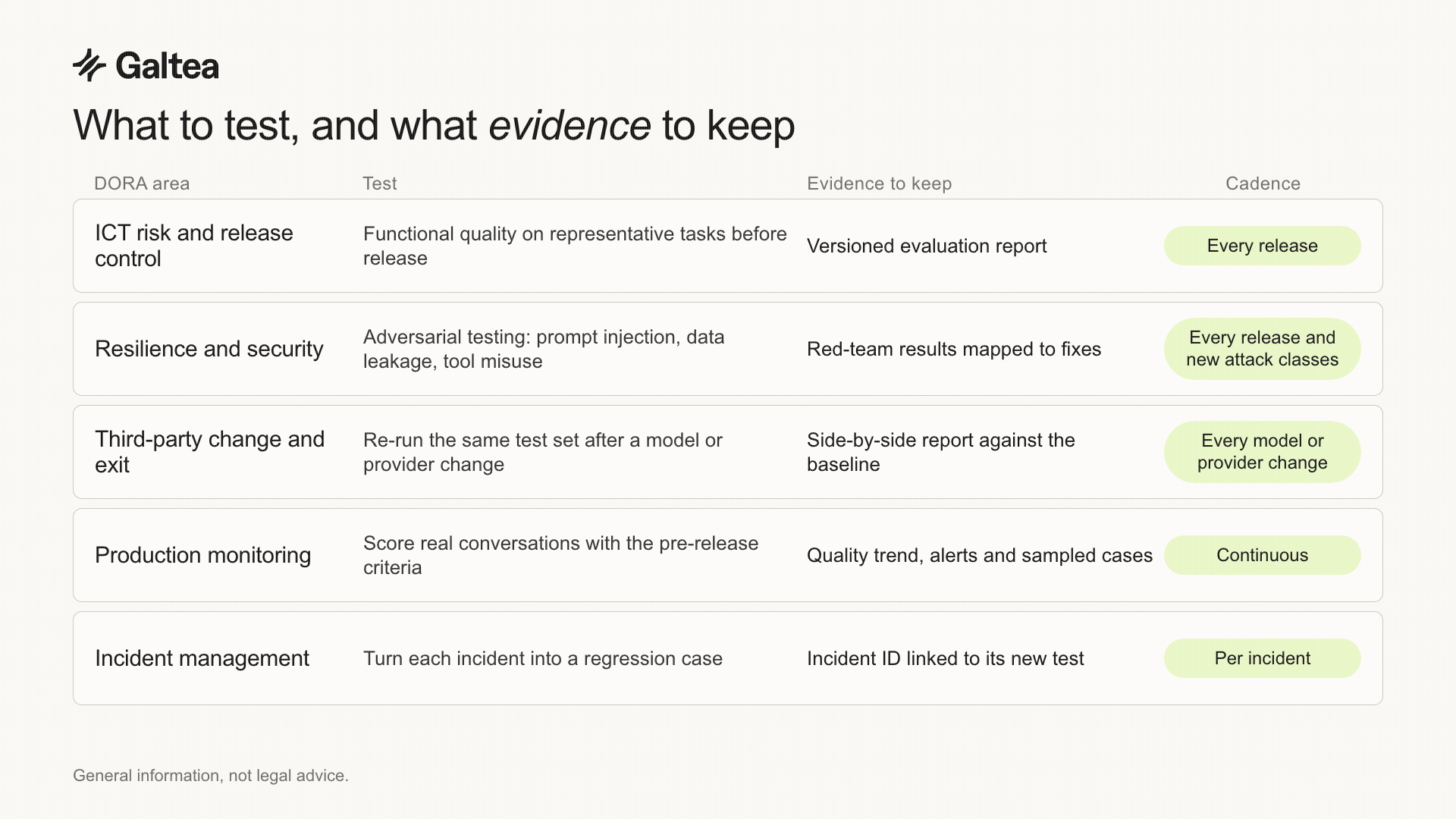
What a bank should test, and what evidence to keep
| DORA area | Test | Evidence to keep | Cadence |
|---|---|---|---|
| ICT risk and release control | Functional quality on representative tasks before release; thresholds agreed with the business owner | Versioned evaluation report with dataset, criteria, judge settings and result | Every release |
| Resilience and security | Adversarial testing: prompt injection, data leakage, tool misuse | Red-team results mapped to findings and fixes | Every release, plus on new attack classes |
| Third-party change and exit | Re-run the same test set after a model or provider change; compare against the previous baseline | Side-by-side report that attributes differences to what changed | On every model or provider change |
| Production monitoring | Score a sample of real conversations with the same criteria used before release | Trend of quality metrics, alerts raised, sampled cases | Continuous |
| Incident management | Convert each incident into a regression case | Incident ID linked to the new test and its result | Per incident |
Re-run these tests on every version of your assistant
We show you how to run the same evaluation after every model, prompt or provider change and compare the results.
Third-party and concentration risk: test what happens if the model changes
The weak point of many AI deployments is that the only evaluation was run once, by the team that built the assistant, against the model it was built on. If the provider deprecates the model, changes it silently, or the bank decides to move to another, there is no baseline to compare against.
The practical answer is to keep the test set and criteria independent of the model. When the model changes, you re-run the same evaluation and compare. If the new model is cheaper, you can show whether quality held. If you need to leave a provider, you have a measurable definition of "good enough" to test the replacement against. Independence also matters organisationally: an evaluation owned by the second line, and not tied to the vendor that supplies the model, is easier to defend to an auditor.
Worked example: a retail bank's customer assistant
A retail bank launches an assistant that answers questions about cards and accounts. Before release, the team builds a test set from product documentation and past customer queries, scores answers for accuracy, grounding in the documents and correct escalation, and sets a release threshold agreed with the business owner. The report is stored with the model and prompt versions.
Three months later the provider updates the model. The bank re-runs the same set, sees that refusals on fee questions increased, fixes the prompt and ships with a before/after comparison. In production, a sample of live conversations is scored with the same criteria; a complaint about a wrong answer becomes a new test case. At each step the bank holds an artefact it can show to its second line: the report, the comparison, the monitoring trend, the incident-to-test link.
How DORA and the EU AI Act fit together
The AI Act asks what kind of system this is and what obligations follow; DORA asks whether the institution can keep operating, and prove it, when this system fails or changes. A bank deploying a high-risk AI system will meet both, and the same evaluation evidence serves both. Per secondary sources, the high-risk obligations are reported to apply from 2 December 2027 following Regulation (EU) 2026/1744.
Checklist: ten questions your second line should ask
- Is every AI system or agent in production in the ICT asset inventory, with a named owner?
- Which test set and criteria were used before release, and who approved the thresholds?
- Can the evaluation be re-run today and give a comparable result?
- Are results stored per version of model, prompt and data?
- How was any LLM judge calibrated against human reviewers?
- Has the system been tested against prompt injection and data leakage?
- What happens to quality if the provider changes the model?
- Is there a tested exit or substitution plan for each model provider?
- Is production quality measured with the same criteria as pre-release?
- Does every incident produce a new regression test?
How many of these ten questions can your team answer today? Review them with us in a demo.
FAQ
Does DORA apply to generative AI and LLM agents?
Not as a category. DORA applies to financial entities and the ICT systems and services they use. An LLM or agent used in operations is ICT, so the testing, third-party and incident rules are relevant.
What does DORA require a bank to test before releasing an AI assistant?
DORA requires a risk-based testing programme for ICT systems; it does not prescribe AI test cases. In practice, banks should show the assistant behaves within agreed limits on accuracy, safety and security, and keep repeatable evidence.
Is an LLM provider an ICT third-party service provider under DORA?
It can be, depending on the service contracted and how it supports the bank's functions. Legal and procurement should assess each arrangement; this article is not legal advice.
What is concentration risk in DORA article 29, and how does it apply to AI models?
Concentration risk is excessive dependence on one provider or a small group of them. For AI, it means asking what happens if the model is withdrawn or changed, and whether you can test a substitute.
How do you prove an AI system is resilient when its output is non-deterministic?
With repeatable statistical evaluation: fixed test sets, explicit criteria, calibrated judges, results stored per version, and the same metrics monitored in production.
How does DORA relate to the EU AI Act for banks?
The AI Act classifies AI systems by risk; DORA covers operational resilience and third-party risk. Both rely on evidence that the system was tested and can be monitored.


