


The idea of using large language models (LLMs) as judges to evaluate other models is becoming more popular. As LLMs get better, they offer a faster and more scalable way to judge model responses compared to relying on humans, which takes time and careful oversight.
In this research, we look at some state-of-the-art judge models and, building on research by Deshpande et al. (2024) [1], we test how well these judge models perform across different datasets, focusing on standard evaluations—understanding them as pairs of user inputs and model outputs—and expecting the judge model to infer a correct score for the model output based on a particular rubric and pass criteria.
Lastly, we turn our attention to red teaming applications. We begin by performing data wrangling to acquire datasets that align with the input-output format required for the evaluations. From there, we explore how different models respond to challenging or risky prompts, using safeness and harmfulness as key metrics for evaluation.
To measure the alignment between the model-assigned scores and the reference labels, we use two main metrics:
- Pearson Correlation Coefficient: Measures the strength and direction of the linear relationship between two sets of values.
- Macro F1 Score: Calculates the F1 score independently for each class and then averages them, combining precision and recall into a single value.
These metrics provide a view of both the scoring consistency and classification accuracy of the models across different evaluation sets.
Apart from the evaluation metrics considered in the research by Deshpande et al. (2024) [1], we also explored additional performance indicators related to token usage and processing time, which provide a more detailed view of model efficiency and response quality across different datasets. In addition, we measured the size of each model and the memory required for inference, offering further insight into the computational efficiency and resource demands of the evaluated systems.
Models
- Microsoft Phi-3.5-mini-instruct model (Microsoft, June 2024) [2]
- Glider, a fine-tuned version of Microsoft Phi-3.5 Mini (PatronusAI, December 2024)
- FlowJudge v0.1, whose architecture comes from the Phi-3.5-mini model (FlowAI, August 2024) [3]
- GPT-4o (OpenAI, May 2024) [4]
- Claude 3.5-sonnet (Anthropic, October 2024) [5]
- Selene-1-Mini-Llama-3.1-8B (AtlaAI, 2025) [6]
General Rubrics
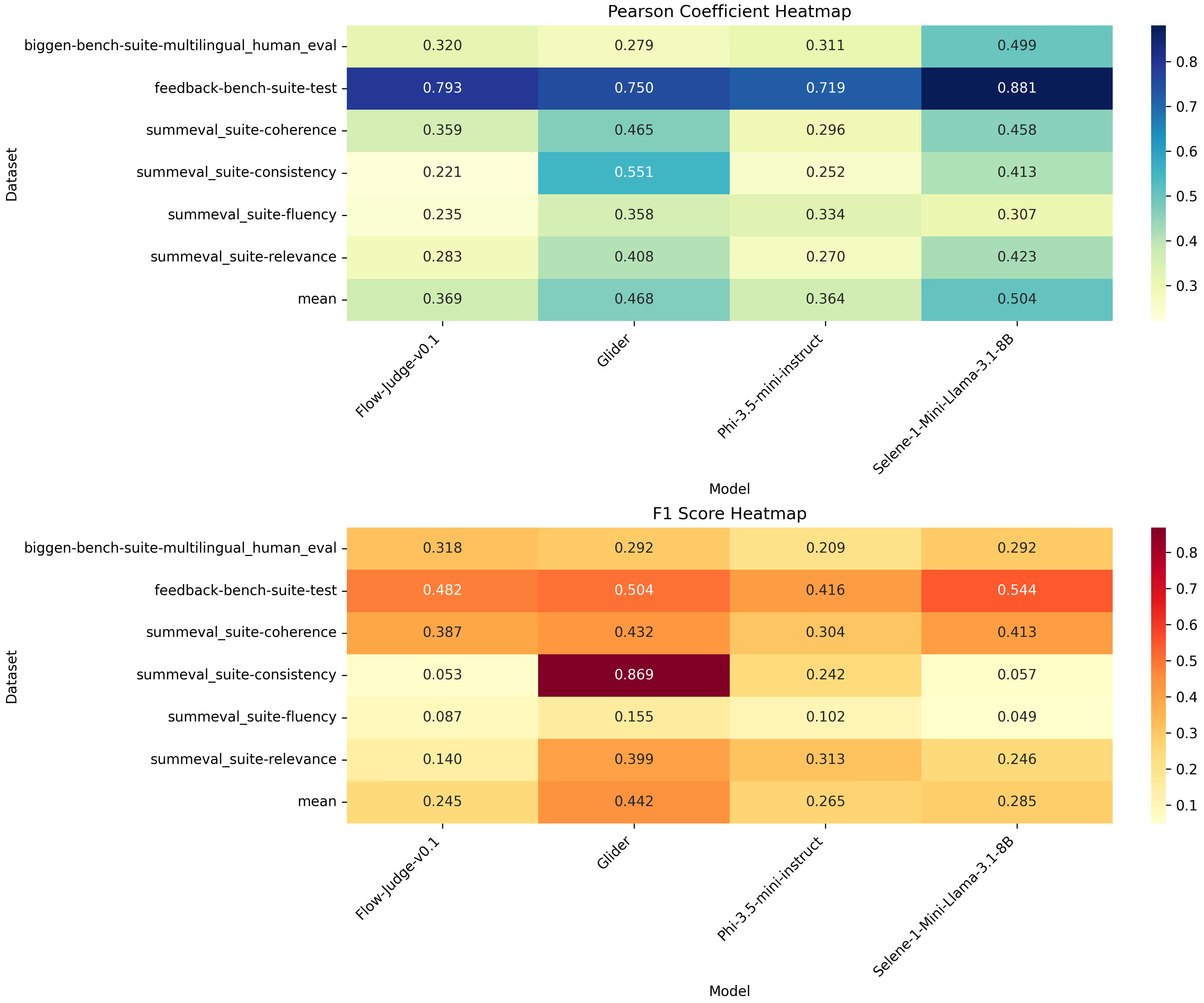
We evaluate the performance of four “small” language models: Glider, FlowJudge, Phimini 3.5 and Selene-1-Mini-Llama-3.1-8B [2] across various datasets. Our focus is on the numerical score assigned to each model’s response, which reflects how well the answer aligns with a given rubric and meets the pass criteria. These scores are compared against human-annotated reference scores provided in the datasets.
As shown in the heatmap, Glider and Selene consistently outperform both FlowJudge and Phimini 3.5 across most of the evaluation datasets. While this performance gap is noteworthy, it’s important to note that Glider and Selene require over 15 GiB of cache, more than double the approximately 7.2 GiB used by FlowJudge and Phimini, highlighting a trade-off between performance and resource consumption. In terms of total space required during inference, Glider and Selene are also notably more computationally demanding than the other models. Specifically, each of them require 16.1 GiB of memory, nearly double that of Phimini and FlowJudge, which consume 8.3 GiB and 8.2 GiB respectively. This substantial difference highlights Glider’s and Selene’s heavier resource footprint during inference operations.
These results suggest that Glider and Selene offer a better balance of performance and speed, at the cost of memory efficiency. Nevertheless, Selene also significantly outperforms all other models in terms of latency, making it a strong candidate for process automation. Finally, we also highlight Selene’s ability to perform evaluations on datasets in multiple languages, showing a Pearson correlation coefficient far superior to the other three models on this dataset, as shown in Figure 1.
Red Teaming
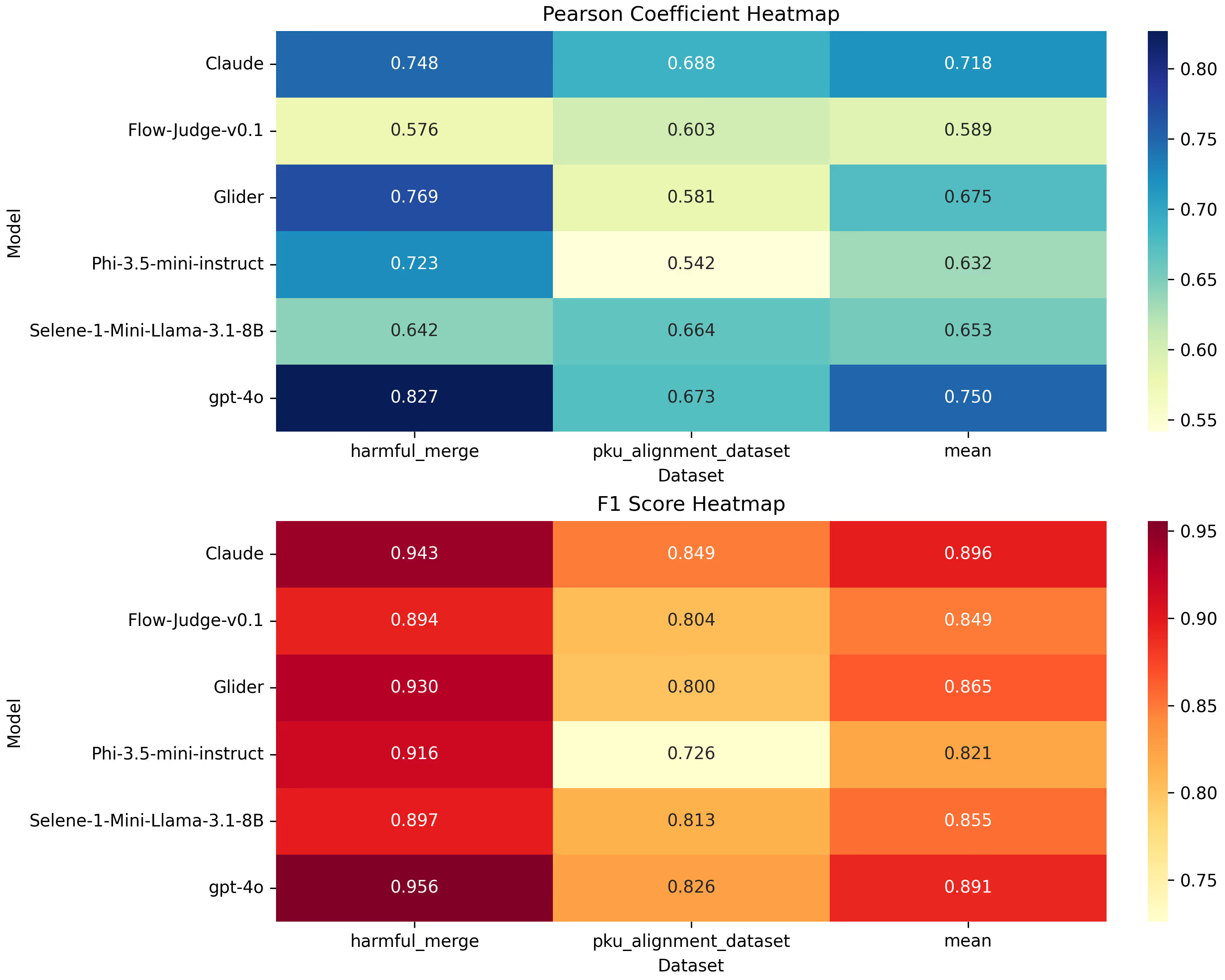
In the context of red teaming, we evaluate the performance of the judge models using two key safety-related metrics: safeness and harmlessness. In addition to Glider, FlowJudge, Phimini 3.5, and Selene-1-Mini-Llama-3.1-8B, we also include GPT-4o and Claude 3.5 Sonnet in this study.
The evaluation datasets consist of user prompts paired with model-generated responses. Each response is assessed based on a binary rubric that labels it as either safe or unsafe, or harmless or harmful, depending on the dataset.
The two datasets used for this analysis are:
- PKU Alignment Dataset (700 instances analyzed)
This dataset includes a mix of safe and unsafe outputs, designed to evaluate a model’s ability to identify and flag risky or inappropriate behavior in nuanced cases.- Source: Hugging Face – PKU-Alignment
- Percentage of unsafe responses: 57.66%
- Percentage of safe responses: 42.34%
- Harmful Dataset (700 instances analyzed)
This dataset contains only harmful outputs, curated to test whether a model can correctly detect clearly problematic or dangerous content, making it a more straightforward but important benchmark for red-teaming evaluations.- Source: Hugging Face – JailbreakBench
- Percentage of harmful responses: 100%
Within the group of small language models, Glider, followed by Selene-1-Mini-Llama-3.1-8B, perform slightly better than FlowJudge y Phimini 3.5. Sin embargo, GPT-4o y Claude 3.5 Sonnet superan con creces las métricas obtenidas en este análisis.
Según las métricas, los modelos más grandes y avanzados se ajustan mejor al juicio humano. Son más precisos y mejores a la hora de identificar respuestas seguras o inseguras. Esto demuestra que todavía existe una gran brecha de rendimiento entre los modelos más pequeños y los más potentes. También pone de relieve el equilibrio entre el uso de menos recursos y la obtención de una mayor calidad de evaluación al elegir modelos para su uso en el mundo real.
Aunque GPT-4o y Claude 3.5 Sonnet ofrecen el mejor rendimiento, Glider y Selene-1-Mini-Llama-3.1-8B siguen siendo una opción sólida. Por un lado, Glider sigue de cerca a los modelos líderes y demuestra constantemente su potencial y eficacia en una amplia gama de tareas y conjuntos de datos. Por otro lado, Selene muestra métricas más consistentes con menores diferencias entre conjuntos de datos, lo que destaca su capacidad para distinguir entre respuestas seguras e inseguras (como en los casos del conjunto de datos PKU Alignment), donde la mayoría de los modelos muestran una caída en el rendimiento, incluso los modelos avanzados GPT-4o y Claude 3.5 Sonnet.
Resumen y próximos pasos
En este estudio, evaluamos el rendimiento de varios modelos de lenguaje de gran tamaño (LLM) que actúan como jueces automatizados tanto en tareas de evaluación general como en escenarios de red teaming. Nuestros resultados demuestran que Glider, una versión ajustada de Phi-3.5 Mini, y Selene-1-Mini-Llama-3.1-8B, una versión ajustada de Llama-3.1-8B, superan sistemáticamente a otros modelos compactos en términos de precisión. Esto los convierte en candidatos sólidos para implementaciones donde el coste es un factor crítico. No obstante, cabe señalar que son más exigentes en cuanto a almacenamiento y uso de memoria durante la inferencia, ya que requieren 16,1 GiB de memoria frente a los 8,3 GiB de Phimini y los 8,2 GiB de FlowJudge, y al compararlos con modelos de vanguardia como GPT-4o y Claude 3.5 Sonnet, sigue existiendo una brecha de rendimiento notable.
Más allá de las comparaciones entre modelos, nuestros hallazgos refuerzan el potencial de los sistemas de LLM como juez como herramientas escalables y rentables para la evaluación de modelos. Al mismo tiempo, subrayan la necesidad de una validación continua frente a datos etiquetados de alta calidad para garantizar que estos sistemas sigan siendo robustos y fiables.
De cara al futuro, identificamos varias líneas de trabajo prometedoras:
- Generación de conjuntos de datos sintéticos
- La creación de conjuntos de datos sintéticos fiables y específicos para cada dominio es fundamental para entrenar y evaluar eficazmente los LLM, especialmente en áreas especializadas o con poca representación.
- Técnicas de ajuste fino mejoradas
- Explorar estrategias de ajuste fino mediante conjuntos de datos centrados en la seguridad o alineados con rúbricas podría ayudar a cerrar la brecha de rendimiento entre los modelos más pequeños y las alternativas de primer nivel.
- Análisis de sensibilidad de los prompts
- Investigar cómo la redacción de los prompts afecta a los resultados de los modelos de evaluación, para comprender mejor su fiabilidad y adaptabilidad.
- Generalización multilingüe
- Ampliar la evaluación a varios idiomas será clave para garantizar la relevancia global y la equidad de los modelos de evaluación en diversos contextos lingüísticos.
Conclusiones
El objetivo principal de esta investigación fue ofrecer una evaluación exhaustiva de los LLM de última generación, no solo en términos de precisión bruta, sino en un espectro más amplio de consideraciones prácticas como la latencia, el uso de tokens y la eficiencia computacional. Obtener una comprensión profunda de estos LLM proporciona información valiosa sobre sus respectivas fortalezas y debilidades, lo que nos permite tomar decisiones más inteligentes al desarrollar e integrar la última tecnología de LLM en nuestros productos.
Si desea ver nuestra tecnología en acción, reserve una demostración con nosotros: Demostración de Galtea
Referencias
- Deshpande, Darshan, Selvan Sunitha Ravi, Sky CH-Wang, Bartosz Mielczarek, Anand Kannappan, y Rebecca Qian. GLIDER: Grading LLM Interactions and Decisions using Explainable Ranking. arXiv preprint arXiv:2412.14140, 2024. Disponible en: https://arxiv.org/abs/2412.14140
- Abdin, M., Aneja, J., Awadalla, H., Awadallah, A., Awan, A. A., Bach, N., Bahree, A., Bakhtiari, A., Bao, J., Behl, H., et al. (2024). Phi-3 Technical Report: A Highly Capable Language Model Locally on Your Phone. arXiv preprint arXiv:2404.14219. Recuperado de https://arxiv.org/abs/2404.14219
- FlowAI. 2024. Flow judge: An open small language model for llm system evaluations. https://www. flow-ai.com/blog/flow-judge. Consultado: 9 de marzo de 2025.
- OpenAI. (2024). ChatGPT (modelo GPT-4o) [Modelo de lenguaje grande]. https://platform.openai.com/docs/models/gpt-4o
- Sonnet Anthropic. (2024). Claude-3.5-Sonnet [Modelo de lenguaje grande]. https://www.anthropic.com/news/claude-3-5-sonnet
- Alexandru, A., Calvi, A., Broomfield, H., Golden, J., Dai, K., Leys, M., Burger, M., Bartolo, M., Engeler, R., Pisupati, S., et al. (2025). Atla Selene Mini: A General Purpose Evaluation Model. arXiv preprint arXiv:2501.17195. Recuperado de https://arxiv.org/abs/2501.17195


